
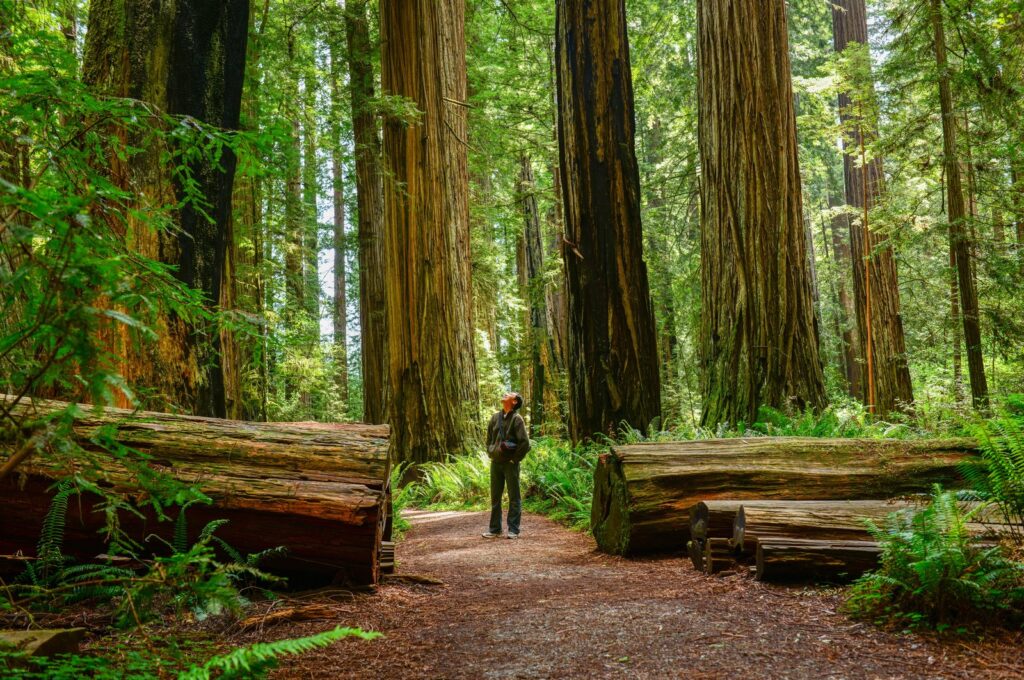
The first time you stand at the base of a 300-foot coast redwood, craning your neck to glimpse its crown disappearing into the fog, something shifts. These trees were saplings when Rome fell. They’ve survived wildfires, floods, and centuries of storms. And they’re still growing.
Redwood National and State Parks—a cooperative collection of one national park and three state parks along California’s far north coast—protects nearly half of the world’s remaining old-growth redwood forest. It’s a five-hour drive north of San Francisco, but the journey rewards you with some of the most humbling landscapes in North America.
The Best Groves to Visit
Start at Lady Bird Johnson Grove, a gentle 1.4-mile loop that winds through old-growth forest just off Bald Hills Road. The trail is mostly flat, accessible, and offers an intimate introduction to these giants without the crowds you’ll find farther south in Muir Woods. Early morning visits often come with fog drifting through the canopy—the redwoods’ lifeblood during dry summer months.
For a more challenging hike, head to Tall Trees Grove, home to some of the park’s tallest specimens. You’ll need a free permit from the visitor center, and the access road requires careful driving, but the 4-mile round-trip hike delivers solitude and trees that top 360 feet. Only 50 permits are issued daily, so arrive early or reserve ahead during summer.
Fern Canyon in Prairie Creek Redwoods State Park is worth the bumpy drive down Davison Road. Fifty-foot walls draped in five-finger ferns create a prehistoric corridor that served as a filming location for Jurassic Park. Wear waterproof boots—you’ll be crossing Home Creek multiple times. The canyon is most lush in spring and early summer.
The Coastal Connection
The redwood parks aren’t just about trees. The system includes 40 miles of rugged coastline where Roosevelt elk graze in seaside meadows and gray whales pass offshore during migration season (December through April heading south, March through May heading north).
Gold Bluffs Beach offers primitive camping right on the sand, with elk often wandering through camp at dawn. It’s first-come, first-served and fills quickly on summer weekends. The beach stretches for miles with almost no one on it—a sharp contrast to Southern California’s crowded shores.
Drive the Newton B. Drury Scenic Parkway, a 10-mile alternative to Highway 101 that tunnels through old-growth forest. Pull over at the Big Tree Wayside to see a massive redwood that’s been a roadside attraction since the 1950s. The parkway also accesses several excellent trails, including the Cathedral Trees Trail.
When to Visit and Where to Stay
Summer brings the most reliable weather, but also the thickest fog and highest visitor numbers. September and October offer clearer skies, warmer temperatures, and far fewer people. Winter can be rainy, but the forest takes on a different character when rain drips from every branch and banana slugs emerge by the hundreds.
Base yourself in the tiny towns of Orick, Klamath, or Crescent City. Lodging is limited and fills fast—book months ahead for summer visits. The park operates several campgrounds, from the developed Jedediah Smith Campground (with hot showers) to backcountry sites accessible only on foot.
Crescent City, the largest town near the parks, has grocery stores, gas stations, and a surprising number of good restaurants. Don’t miss the Ocean World aquarium on the harbor, where you can watch harbor seals being fed and even hold a sea star.
Practical Tips for Your Visit
Cell service is spotty to nonexistent throughout the parks. Download maps before you arrive. The official NPS app works offline and includes trail details and points of interest.
Layer your clothing. Coastal temperatures hover in the 50s and 60s even in summer, and the fog can roll in without warning. Mornings in the forest can be chilly, while inland areas warm significantly by afternoon.
Give yourself more time than you think you need. The drive from the southern entrance at Orick to the northern Jedediah Smith section takes over an hour, and that’s without stopping. Most visitors underestimate the park’s size and end up rushing through groves that deserve slow, quiet attention.
Stop at the Thomas H. Kuchel Visitor Center near Orick for orientation, permits, and current trail conditions. Rangers offer excellent advice on matching trails to your interests and abilities.
The redwoods teach a kind of patience that’s hard to find elsewhere. They’ve been here longer than we can fully comprehend, and they’ll outlast us all. Walking among them isn’t just sightseeing—it’s perspective.
Want more California travel stories delivered to your inbox? Subscribe to the Love California newsletter—one short story a day about the Golden State beyond the brochures.
Tours & experiences in California


Powered by Viator. Some links are affiliate links — we may earn a small commission at no extra cost to you.